
EU Responses to Protests in Serbia, Turkey, and Beyond
The End of Values-Based Engagement was an event that took place on the 24th of March of 2026. It sought out discussion regarding protests in Turkey and Serbia, as well as political instability in the Balkan region as a whole. Hosted and organized by Ozan Poşluk and Marko Stanković, it featured three guests: International Relations professor at Ca Foscari Kerem Öktem, Senior researcher at European Policy Center from Belgrade Marko Todorović, and Alper Kaliber, Senior fellow at Istanbul Policy Center. The guests were asked questions to engage in conversations regarding Balkan relationships with Europe, and their responses showed a variety of viewpoints and analyses.
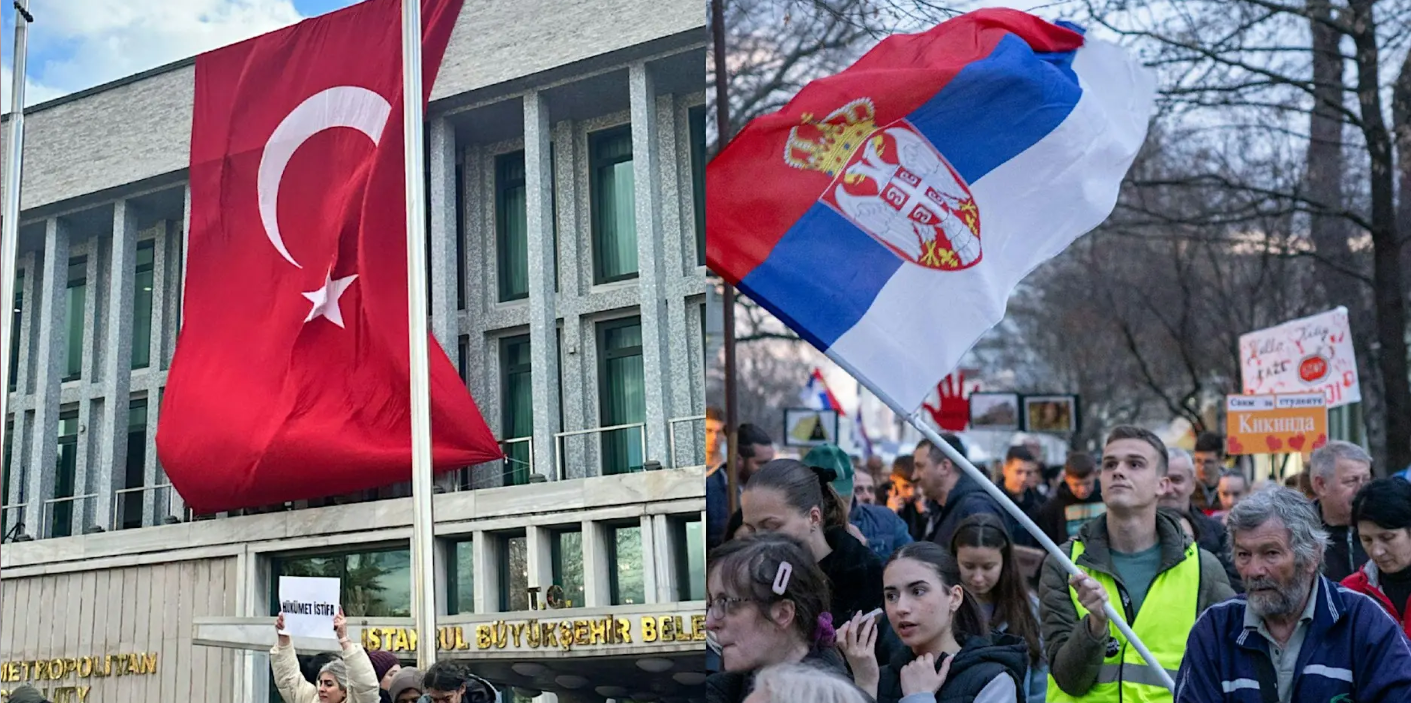
The event started with a rundown of the context leading to the current situation. On the 19th of May of 2025, the mayor of Istanbul was arrested due to corruption-related charges. As a result, student protests ensued. These protests were met with heavy police action. A student from Istanbul was featured to weigh in on his experience, which he described as stressful and a dismantling of the system that they knew. Numerous students were arrested and spent time in prison for participating in protests, besides engaging in active violence at the protests themselves.
In Serbia, the protests were triggered after the fall of the canopy on the train station in Novi Sad, the second biggest city in Serbia, on the 1st of November 2024, which killed 16 people. After almost a month without action from the state organs, the protests began spontaneously, when students of the various universities and cities started to leave their lessons in order to get out on the streets and hold 15 minutes of silence in honor of the 15 known (by that date) victims of the tragedy. One person died later from the injuries.
The protests grew and became the most massive movement in the history of Serbia, gathering hundreds of thousands of people across the whole country. The spontaneous student movement unwillingly used the vacuum of power, created on the political scene due to the people’s disappointment in political opposition after its disunity and bad performances in elections. It quickly became the most powerful political movement in the country, even though the students did not want to admit that until the 15th of March, 2025 when the largest gathering in the history of Serbia was held. This protest was met with the alleged use of a sound cannon, as we heard from a student in Belgrade. She was one of the 80 students that in April 2025, went to Strasbourg on their bicycles to ride 1472km as a call to be noticed by European institutions. After meeting with three members of the European Parliament and the Deputy Secretary General of the Council of Europe, authorities acknowledged their nominal support for their fight for a just and
democratic society but with no practical mechanisms to help the students and rectify the situation, which caused their disappointment in the European institutions.
Todorović was subsequently asked if the people in Serbia share the same sentiment towards the EU which gave him an opportunity to present the recent research conducted by his think tank regarding the matter. A relative majority of citizens (39.8%) support Serbia’s membership in the EU, while 33.8% oppose it. About a quarter of citizens (26.4%) have a neutral attitude, the research results state, adding that support for membership is highest among people aged between 18 and 29, and lowest among the population over 60 years old. Furthermore, as many as 41.8% believe that the EU is trying to integrate Serbia because of access to lithium and natural resources, and as many as 43.9% of citizens believe that for the EU it is more important for Serbia to impose sanctions on Russia than for it to become a developed democracy. Citizens still showed low trust in the impartiality of the EU in the enlargement process, since only 27.7% of citizens believe that the EU applies the same rules to all candidates. And only 25.7% of citizens believe that the EU really wants to integrate Serbia into the European community. Also, a large number of citizens view the EU primarily as a geopolitical actor, and less as a valuable actor, and are suspicious of the EU’s intentions towards Serbia in the enlargement process. As many as 41.6% of citizens believe that the EU is more interested in realizing its own political and economic interests in our region than in the state of democracy and the rule of law. He later commented that as of the last three years, the main obstacles for making progress in the negotiations process are the complex situation of Kosovo and Serbia’s refusal to fully align with the sanctions towards Russia. Another issue regarding Serbia’s difficulty in being accepted fully by the Union, according to Todorović, is lack of freedom of the media, police brutality, and he reiterated the unethical nature of the use of the sound cannon, echoing past statements. The current Serbian situation involves waiting for elections, possibly by the end of 2026. When asked about the resolution of the conflict, he emphasised that there are three political options presented to Serbian citizens. The first being the government coalition, the second as student movement, and the third political opposition. There is no single dominant political course to follow, creating an uncertain future. Todorović remains optimistic regarding student action and a push for change, and he believes that there must be more cooperation between opposing movements to create real action.
Professor Öktem, when asked why protests only began on the 19th of May of 2025, replied that there has been a lot of hopelessness from Turkish people regarding the enactment of a better democratic system. There have been many smaller demonstrations prior to the recent examples, especially from minority groups such as the LGBTQ community and women’s rights activists. These were not met positively, resulting in the incarceration of protestors. He was later asked whether an installment of democracy could occur through hard power, or help from the Council. He stated that the Council cannot do more than the country it targets allows for, and that it is the natural working of the organization. He pointed out a large difference between Serbia and
Turkey, where the EU still has leverage on Serbia and the country remains in talks of joining the EU. Turkey, on the other hand, does not have any prospects of joining the Union creating a lack of possibilities for EU organs to participate in their government actively. He also expressed distrust in institutions built on violence. Serbian protests, as he pointed out, are still centered on seeking aid from Europe, while Turkish protests no longer look up at Europe for aid or as a goal regarding their model of government.
Professor Kaliber was asked what the main motivations of protestors were and who comprised the main body of them. He has said that the main motivations of the protestors were related to the democratic backsliding and decreasing standards of living in the country for more than a decade, and the arrest of Istanbul’s mayor, Ekrem Imamoğlu, was more of a catalyst than a major motivation, despite him being a popular political figure not just in Istanbul, but also the rest of the country. The demographics were also on the younger side, similar to the Gezi Park protests in 2013, comprising mostly university students and young professionals who also received support from all parts of Turkish society. He further added that the protests still comprise a smaller part of the social movements across the country, unlike the Serbian case. Currently, the main opposition to Erdoğan’s rule is sustained by the Republican People’s Party’s (CHP) efforts, mostly concentrated in rallies across many provinces in the country, and partly due to the brutal police and legal response to the protestors. He also cited this as an example of how opposition politics have been conducted in Turkey for quite a while now, considering the country lacked a nation-wide, inclusive protest movement since 2013’s Gezi Park protests.
He was also asked about the future of Turkish politics as an important actor in the region. He pointed out Turkey’s relationship with other countries in the region, such as Israel, and its influence in the Middle East. The EU is interested in security matters within Turkey; its future depends more on its government and on how much the opposition can organise and act. According to him, Turkey’s multiple entanglements in the region, most particularly the one in Syria, its active support for Ukraine since the start of the full-scale Russian invasion, and its strategic value when it comes to the United States’ conflict against Iran make it indispensable to many of its allies in the rest of Europe and the United States. Despite this rather advantageous situation for the country itself, this could also make Erdoğan’s regime more resilient than before, especially if the Turkish engagement in its immediate neighbourhood gets deeper and deeper. He also delved deeper into the image of Erdoğan as a figure of stability in a complicated world, present in some parts of the Turkish electorate. According to him, this image might be either reinforced or damaged in connection with any spillover effects on Turkey. But as there are too many variables, according to him, the future for Turkey is both bleak and open to all kinds of scenarios.
The Q&A session’s participants ended the event by repeating the point that the idea of both Turkey and Serbia joining the EU might be idealised; however, it does not necessarily represent
the best outcome for either country. This is a new concept for the EU, and consolidating democracies within it that have different pasts can prove to be a unique challenge. The EU’s established democracies have been experiencing a turn towards the right, which affects the entire region, and it shows a difference in the institution, or a “dark side” in Professor Öktem’s words. The event proved to be an incredible learning opportunity and debate space for balkan and non-balkan students alike.
Written by Lia Moreno Samaniego
Photo credits:
2025 Saraçhane Protestoları – Photo by Atomotantik, Wikimedia Commons, CC BY 4.0. (on the left)
Kikinda protest 2025-03-12 – Photo by Sovausara, Wikimedia Commons, CC BY 4.0. (on the right)
Leave a Reply