
On the 26th of January, International Hour had the opportunity to interview Professor Alaedin Al-Sayed, visiting scholar from al-Aqsa University, in Gaza, who has been teaching in our University since October and is an Associate Professor of Management of Human Rights. On the 17th of December, with the organization of Professor Sara Dal Monico, the Professor was invited to hold a private conference for the members of Venice Diplomatic Society, titled “From Gaza to Venice”, which was a powerful moment of reflection on the role of education around the world.
“When hope is fading, Palestinians will find it” – Interview to Professor Alaedin al-Sayed
by Angelica Capelli and Rebecca Basso
Since our last meeting on the 17th of December, a few months have passed and the events occurring in Palestine kept unfolding. As an introduction for our interview, we would like to have your insight on how the situation has developed.
Al-Sayed: Thank you for this interview; it is my pleasure to answer your questions. My opinion on what is happening now in Gaza is that, unfortunately, I do not believe the situation will improve. When we talk about peace and the safety of the Palestinian people, these can only be achieved through elected representation of the Palestinians, and we have the right to manage our own affairs.
During our last meeting, we were deeply touched by your description of the heartfelt dedication that, even in the current gruesome conditions, Palestinian students are showing in their education. We are sure that you have worked with many students that had to deal with such circumstances, but is there a peculiar story that deeply touched you and you would like to share with us?
There are many stories that had a deep impact on my work. I remember that one of my students, Muhammad, was preparing to discuss his thesis on the 7th October and, one week before the war, he showed me the presentation. He was a very motivated student and was planning on who to invite to the graduation and how to celebrate it properly. I sadly lost contact with him after a few weeks of war, since the universities had closed and then heard from his sister that he had been killed, with his wife and kids.
Later, I was conducting interviews for the Master I was about to start teaching. When I asked one of my students to open his camera in order to keep transparency in the interview, he refused. I asked him again and he switched the camera on: he was laying on the bed and other people were holding the mobile for him, since his body was completely burned. He could move only his tongue and eyes and had a tube in his throat to help him breathing. I was deeply moved by his persistence in hiding his pain, in order to pursue his education.
Another one of my master’s students lost all of her family in the war. I kept calling on her to motivate her to keep studying and I gave her another possibility to deliver the mid-term
homework, after she couldn’t submit it on time due to everything that had happened. On the day of the final exam, I kept looking for her until one of her colleagues told me she had reunited with her family: the bombs killed her. All my students did the impossible to keep learning, moving from one shelter to the other and spending extra effort to collect materials and study, while trying to survive the war. A lot of them were able to succeed and graduated.
In our last meeting, you mentioned the destruction of Gaza’s 17 universities, including Al-Aqsa University, where you were employed. What is that you miss most about your everyday working life?
When I was working inside the Ministry of Education’s Department at Al-Aqsa, I had the chance to witness for five years the construction of the newest buildings of the University and I know exactly how difficult it was to build them, to raise funds and equip them. We had established joint ventures and exchange programs with other universities; I personally was friends with fellow colleagues from the other campuses. During the war, I lost many friends and colleagues, and Al-Aqsa University as well. These buildings held a meaning that went beyond the physical structures: Al-Aqsa was my second home for ten years, and I remember going to my office before the guard even opened the gates, to the point that the guard joked about giving me the keys!
I would then leave the building at around six p.m. and I was spending more time with my colleagues than my family, in fact. Working at Al-Aqsa University meant sharing knowledge, meetings, developing programs, and then memories, success, my students’ hopes for their careers: I found myself there. Al-Aqsa was my present and my future.
Since becoming a visiting scholar at Ca’ Foscari University, have you been able to continue your research in Finance and Management? Or has your field of research and academic interest changed in any way since your arrival here?
I was able to continue my research since my friend and colleague Professor Francesco Rullani paved a way for me to organize some seminars at the Management Campus in San Giobbe, allowing me to get to know the staff and booster graduate students in Management and the Human Resources field, which is my specialization. I am currently discussing different projects with Professor Bonesso, Head of the Competency Lab, to share my experience with the students and help them in the best way I can.
Why did you choose Ca’ Foscari as your hosting institution?
I first came to Venice in 2022, on a mobility program, to participate in some courses about Arabic language at the Asian and Mediterranean Studies Department, invited by Professor Sibilio, whom I kept in touch with, he then invited me to a conference held by Universities Ca’ Foscari and La Sapienza in Rome. I found Ca’ Foscari to be a very international university, with many different nationalities, so it is really a treat to be able to work here. If I had the chance to choose another university, I would still choose Ca’ Foscari, which is the reason I want to remain in Venice.
The Venetian Community, within and outside the university, has been deeply involved in the emergency unfolding in Gaza. In which ways have you been able to perceive the solidarity of the city and the institutions?
In the past months, walking around the streets in Venice, I’ve happened to see the Palestinian flag on the windows: just by seeing it I can understand how much Venetians support my people. Not a single person I have met has refused to help me, from colleagues to neighbors. It is really amazing to have people who support us and look after needs we don’t have to think about. Venice has become another home where people have opened their hearts towards us and shared their happiness with us. For example, during the Christmas festivity, I was invited to celebrate with some friends, because my family wasn’t with me and they didn’t want me to be alone. This warm feeling of welcoming is how I would describe the community.
During the conference you held in December, you mentioned the role of education in Gaza as essential, in preserving the national identity of the Palestinians. Do you think that the destruction of the University Facilities of Gaza could be seen as intentional, with the scope of erasing the Palestinian sense of nationhood?
Absolutely. The buildings, the students, and the books had made no harm to anyone. When those who fight kill children and shoot at schools, they intend to kill an entire generation and to make them afraid of the future. The government of Israel is afraid that our youth can claim their full potential through education, so they try to prevent them from asking for their legitimate rights of freedom, independence and dignity. Additionally, we have to remember that the struggles Palestinians are facing trace back to 1948, if not even before. Most people who were refugees, from 1948, knew they had to rely on education in order to improve their condition, because being educated goes far beyond having a competitive advantage in the job market: it can become a passport towards a better world. My parents deeply believed in the power of education to acquire one’s freedom and even my grandparents, who didn’t have the possibility to finish school, gave great importance to the abilities of reading and writing. I too am convinced that education is an added value to the future.
As a matter of fact, the Palestinian people, generation after generation, feel that the identity of their own existence is rooted in education, because it empowers us to properly express their opinion and concerns about the reality, it offers chances for a better career through which we hope to support even more our people. Therefore, even if Palestine is not a land with an enormous population, academics, researchers, professors and students embody our sense of identity, the one we will never surrender.
Professor Al-Sayed, you have shared with us your personal experience and the challenges of adapting to a constant exhausting condition of danger, especially having to look after your families. When you fled from the genocide, you were forced to leave behind your wife and children for more than a year. Was it difficult to keep in touch with them and help them?
When I first decided to come to Italy, it wasn’t just my own decision. Together with my family, we discussed it and I was surprised when they agreed to me leaving them, since I had
been hesitating and worried about leaving my family in Gaza. I had refused to leave my neighborhood to flee to the South area of the Strip but, after losing my father, we moved to a safer area and, as I was setting up the tent, I received the call from the Italian consulate. They asked me if I was willing to leave immediately and I agreed, even if I wanted to discuss the matter with my family. My wife, daughters and sons encouraged me to go so that one of us could be safe and to help them from outside of Gaza, by sending money. My daughter told me she was sure we would eventually be reunited.
I hence came to Italy, but my frustration and fear were growing, as I could immediately bring my family to safety. Then I got to know about the IUPALS Project [an initiative of the Italian universities, coordinated by the Minister of Foreign Affairs, that allows Palestinian students to travel to Italy with a study permit, ndr.] but they weren’t able to help me. Meanwhile, time passed, but I was determined to never lose hope and, on the 28th of December, I received a call from the consulate, informing me about a possibility to bring my family to Italy. After around two weeks of preparation, in which I provided everything they needed to get out of Gaza, I was finally able to reunite with them.
What was the hardest part of your families’ journey to Italy?
When I received a call from the consulate, they only had a couple of days to get ready to travel from Gaza to Jordan but, because their trips started at 4 a.m. in the morning, they had a short period of time to travel from one city to the other, to avoid moving in the darkness because of dangers and lack of transportation. They had to say goodbye to all of our remaining relatives and friends really quickly, and that was definitely not easy. Another issue is that the regulations to expatriate are very strict: when crossing the border between Gaza and Jordan, they could not carry anything with them, aside from documents, one mobile phone and a little money. They suffered from the cold weather for twelve hours. They later told me that, as they were moving from Khan Younis to Rafah, they saw both cities, once beautiful, completely destroyed. Although devastated, they were able to admire the beauty of our land, its streets and buildings, one last time.
Especially in these final weeks of exam session, the most common feeling among our students is a sense of duty each of us has wished we could avoid at least once. Instead, the description you have made so far of the Palestinian students is one of young people filled with love for knowledge and bright hopes of crafting a better future. What is your message to our students? What would you say to help us remember that, even in the hardest times, education is a privilege, instead of a burden?
My dear students, look at the opportunities that are in front of you while there are other young people that are struggling to get access to what you take for granted. You have so many chances to be excellent, and if you ever feel like giving up just try to imagine how students in Gaza study with the cold, with the bomb noises, in constant fear and not being able to focus, with the constant thought of surviving. Sometimes there can be no internet connection or no electricity after 5 p.m., and they have to walk for miles to charge their phones or laptops. With all the advantages you have in your hands, all that is required from
you is only to be creative, so that you can do more than just be successful in your studies and make the world a better place for good.
One last question for you, Professor. This month’s newspapers [the interview was held at the end of January, ndr.] have been dominated by the discussion on the newly created Board of Peace, with the supposed goal of leading the reconstruction of Gaza. The Italian government has declined President Trump’s invitation to join as an active member, in claims of possible unconstitutionality. How do you feel about this decision? What hopes do you have regarding the future government in Gaza?
It’s not easy to talk about the future of Gaza, since it is really difficult to forecast what will happen. Surely, I don’t believe that the Board will bring actual peace, as it cannot come from criminals: I think that any government of Palestine must be elected by its people. We have different political parties, of course, but they all stand united regarding the opposition of occupation by foreign bodies and new forms of colonialism. Whereas, the Palestinian presence on the Board is too limited to be impactful.
However, I still feel some hope, as there are people in other countries that are supporters of a Palestinian political independence and will help us to protect the dignity of our people. Even if there was no hope, it is our duty to search until we find it.
In contemporary conflicts, statistics circulate more rapidly than testimonies. Casualty counts, percentages of displaced populations, and satellite imagery of destroyed infrastructure often become the dominant language of international response. Yet, the interview and the discussion we had the opportunity to work on, force a reconsideration of this abstraction. To take this testimony seriously is to resist the temptation of reduction. It is to acknowledge that behind every percentage lies a person who once prepared lectures, who once dreamed of building laboratories, who once waited for an exam result, who once feared that a child’s silence on the phone signaled death. It is to affirm that the language of policy must remain accountable to the language of lived experience. Above all, it is to recognize that the struggle to remain more than a number is itself an assertion of humanity. We, as International Hour and Venice Diplomatic Society, thank the Professor for letting us take part in sharing his personal point of views and experiences, so that more of us can know what is really happening.
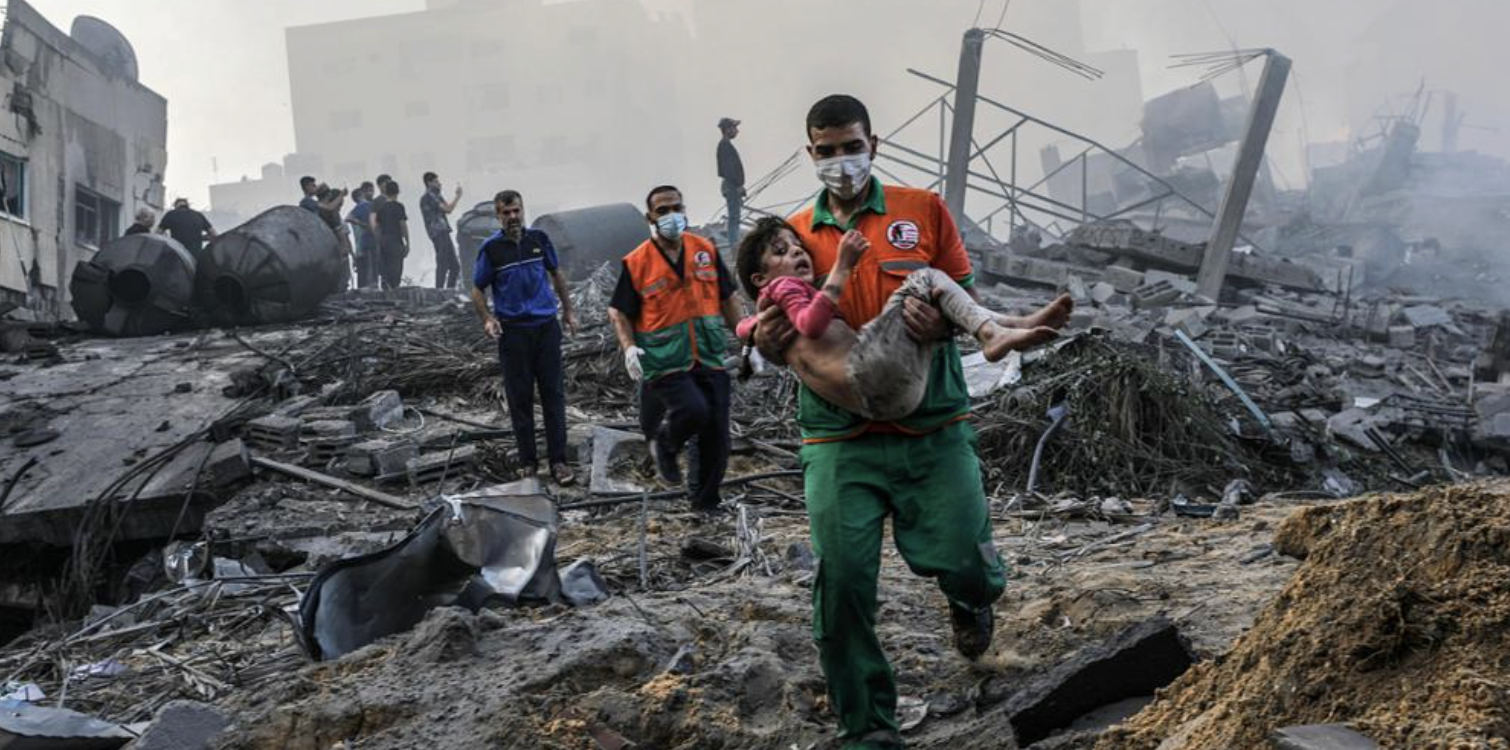
Photo credit: Il giornale La Stampa
Leave a Reply