
Written by Lorena Barbaro and Stefaniia Orlova
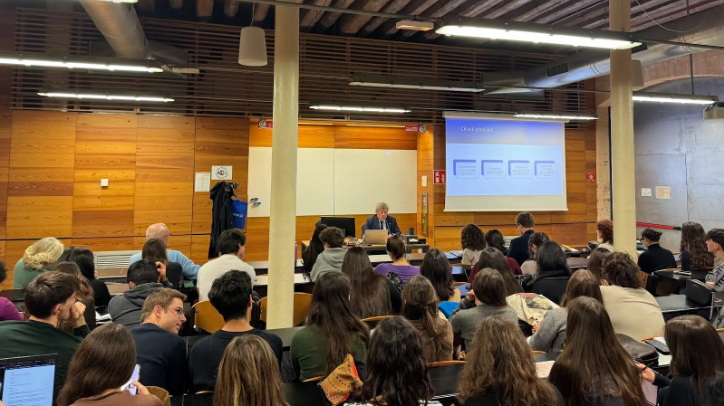
On December 3rd, students of Ca’ Foscari University attended a meeting of particular relevance for those studying international relations: a public lecture delivered by a practicing diplomat whose professional profile reflects a non-traditional model of diplomatic engagement. The speaker was Claudio Scarpa, who has served as the Honorary Consul of the Oriental Republic of Uruguay in Venice since 2017.
The lecture opened with an unconventional visual reference. Displayed on the screen was an image of an aircraft preparing for departure, accompanied by a solitary figure against an urban background. This image corresponded to the cover of an investigative report published by L’Espresso, entitled “Consoli Onorari Intoccabili” (“Untouchable Honorary Consuls”), which analyzes the legal status and privileges of honorary consuls in Italy.
According to Scarpa, the report reflects a widespread assumption that Honorary Consuls are often perceived as equivalent to career consuls, enjoying comparable privileges and a degree of immunity commonly associated with the notion of diplomatic “untouchability.” By introducing his lecture through this reference, Scarpa raised a central question that would structure his presentation: to what extent do such assumptions accurately reflect the legal status and practical responsibilities of honorary consuls?
Although beginning on such a critical note might have appeared unexpected, this choice was intentional. From the outset, Scarpa sought to clarify the nature of his role and to address prevailing misconceptions surrounding Honorary Consular positions, emphasizing the distinction between formal diplomatic status and the realities of everyday consular practice.
Who honorary consuls are and why they are important
As previously hinted, Honorary Consuls are not career diplomats, but individuals appointed for their experience, reputation, and network of connections. In fact, diplomacy today is
increasingly shifting toward honorary rather than career-based representation, a trend clearly visible in Italy, where out of 681 consulates only 109 are career posts.
But what is the reason behind this change? As Scarpa explained, it stems from a combination of needs, mainly to establish diplomatic representation and reduce costs related to it. When the resources to sustain embassies or full consulates are lacking, honorary diplomacy becomes the practical alternative. And indeed, this also means that Honorary Consuls do not receive a salary for their work, something that often surprises those unfamiliar with the role.
The importance of Honorary Consuls
Despite the differences between career and Honorary Consuls, they share many of the same responsibilities: citizens assistance with notarial or administrative matters, promotion of economic and cultural ties, representation, and the reception of important figures. At times, their duties also extend to more unexpected situations, such as the case Scarpa recalled of a Uruguayan politician who wanted to buy property in Italy but did not speak the language, and for whom the consul ended up managing the entire process on his behalf.
What Scarpa emphasized most, however, was that “the main requirement to become a consul is not titles or a career. It is contacts.” Honorary Consuls are often highly trusted individuals with deep roots in the territory they serve or with a history of contributing to it. These “contacts” are not limited to knowing influential people, but they refer instead to the meaningful and genuine bond a consul develops with the local community, and equally with the country and people they represent, whom Scarpa speaks about with heartfelt passion.
Such a connection becomes especially valuable in moments of tragedy, like the 2023 Marghera bus accident, in which many foreign passengers lost their lives when the bus fell from an overpass. In times like these, support, empathy, and a genuinely human presence can offer comfort to families facing unbearable loss.
A misunderstood role
An important part of the conversation revisited the initially mentioned misconceptions and the topic of diplomatic immunity, particularly for honorary consuls. At times, Honorary Consuls face a dual stigma because their position exists somewhere between that of a career consul and a private citizen. On one hand, they are sometimes perceived as privileged
because they are associated with the authority of career consuls. However, as Scarpa explained, Honorary Consuls enjoy very limited immunities compared to career consuls, who themselves have far less than ambassadors. Their diplomatic immunity applies in a limited way, only when performing official duties, and the inviolability of consulate premises is also restricted, because honorary consulates tend to operate in private rather than institutionalized offices, where protection often extends merely to a “consulate closet”.
On the other hand, Honorary Consuls are sometimes perceived as “not proper consuls” precisely because their position is honorary. Scarpa recalled honorary consuls being disparagingly described as “those who just play consul” and shared examples of the disrespect this perception can cause. In many cases, Uruguayan citizens were stopped at the airport while traveling with emergency passports issued by Scarpa’s consulate, requiring him to personally intervene to explain the situation and secure the necessary permissions.
This dual perception, overestimated but at the same time undervalued, highlights the delicate balance honorary consuls must navigate, as well as the misunderstandings that often surround the role.
Uruguay and Italy: history, culture, and unexpected facts
It was surprising to learn just how closely Uruguay is connected to Italy. According to Scarpa, up to 40% of Uruguayans have Italian roots, and the country was profoundly shaped by European migration, a legacy that continues to influence its culture, language, cuisine, and politics.
He also shared an episode that few people know: Giuseppe Garibaldi, the hero of the Italian Risorgimento, spent time in Uruguay early in his career, where he led a group of 500 volunteers during a civil war, achieving a significant military victory that contributed to securing the country’s independence. Today, a statue of Garibaldi stands in Montevideo, commemorating his role. His story, therefore, is tied not only to Italy but also to Latin America, which explains why he is often called the “eroe dei due mondi”, the hero of two worlds.
Scarpa highlighted one more connection by pointing to Rivera, a city in northern Uruguay, where a unique blend of Venetian dialect and Spanish developed over the centuries,
representing yet another unexpected link between Uruguay and Italy, and in particular the Veneto region.
How to become an Honorary Consul?
A question that, undoubtedly, many in the room were quietly waiting to ask. Scarpa answered honestly: to become an Honorary Consul, one must be a resident of the host country, possess an impeccable reputation, maintain strong connections and an active professional life, being genuinely involved in the region’s community. Not to mention that one must also be prepared to take on significant responsibility, as initially anticipated, without receiving a salary.
Even with an application, the ultimate decision lies with the state seeking representation, which assesses whether the candidate’s profile aligns with its interests in the region and whether the person can genuinely serve as a bridge between the two societies. In that sense, being chosen as a consul is both an honor and a recognition of the trust placed in the individual.
A colorful dream
At the end of the meeting, Scarpa showed a slide with a quote from Giuseppe Bortolussi:
“If you dream, don’t dream in black and white, dream in color. And then, upon awakening, pursue your dreams.”
This phrase was not just a poetic way to close his presentation, but also his message to the students: “One can, and indeed should, dream of an international career, but it is those who act on them who actually make their dreams come true” – a reminder that ambition becomes reality only when paired with initiative.
For some, diplomacy is a matter of protocol and formalities. For an Honorary Consul, however, it is made of people, stories, and unexpected encounters, the kind that can alter someone’s path, or even destiny.
Leave a Reply