
Written by Stefaniia Orlova and Angelica Capelli
Introduction
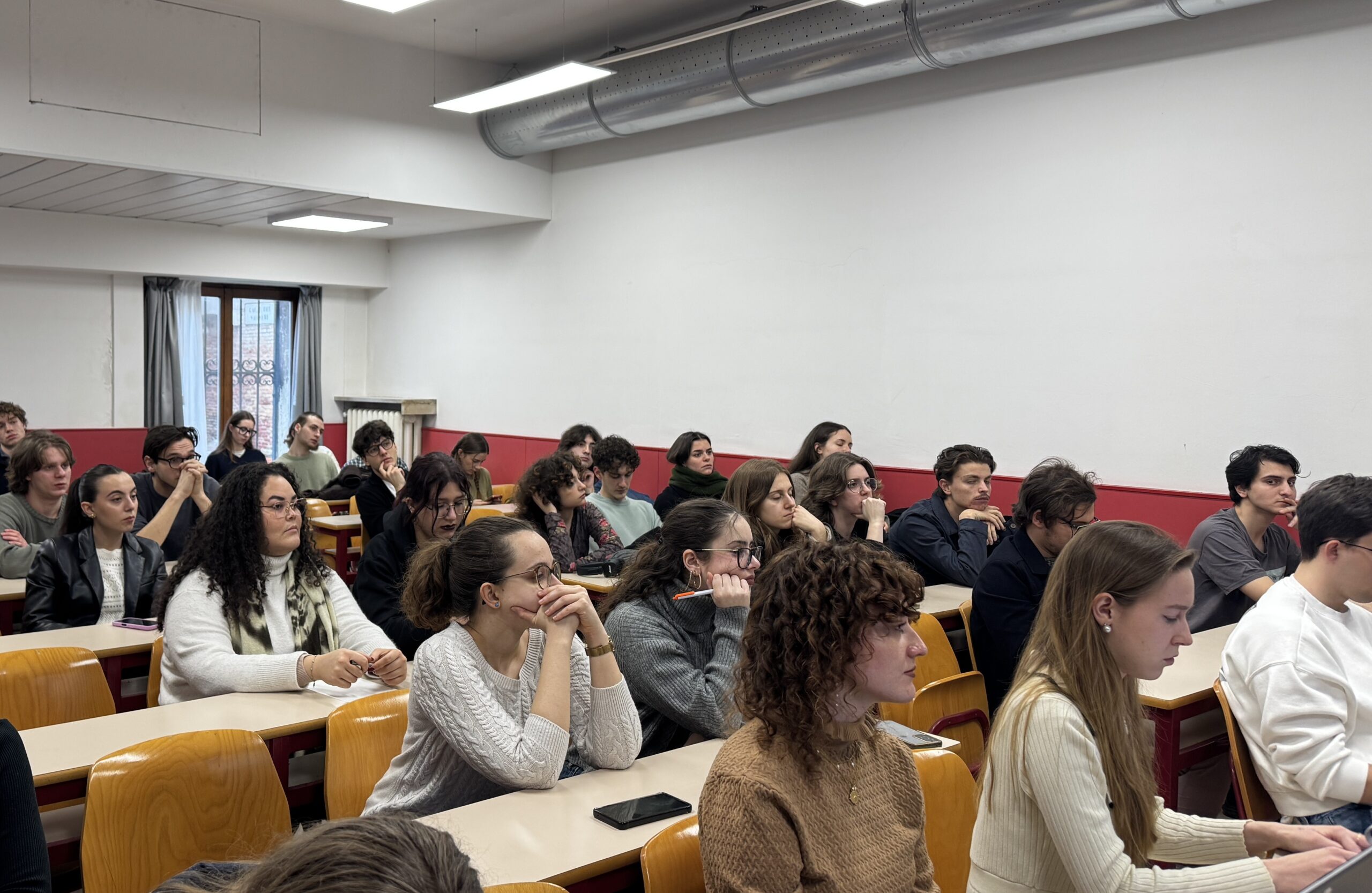
On January 30th, a fascinating discussion took place at Ca’ Foscari University in Venice, examining the consequences of US intervention in Venezuela. The so-called Operation Absolute Resolve, through which a special force belonging to the U.S. Army kidnapped President Maduro on 3rd January, was examined from the perspectives of international law, geopolitics, economics, and social processes. Participants discussed whether the US operation represents a return to imperialist policies, the real motives behind Washington’s actions, and the implications for Venezuela and Latin America as a whole. The three key speakers who participated in the debate, coordinated by VDS Board Member Mariachiara Giglio, were Vanni Pettinà, Professor of American History and Institutions and Coordinator of the Cattedra del Messico at Ca’ Foscari University of Venice; Fausto Randazzo, Italian-Venezuelan Master’s student and former member of Venice Diplomatic Society; and Lia Moreno, Ecuadorian Bachelor’s student and Coordinator of the VDS Debate Society.
Geopolitics, International Law, and US Imperialism
The first speaker, Professor Pettinà, characterized the capture of the Venezuelan president Maduro as an extraordinary event, one that goes beyond the normal practice of international relations and international law. He emphasized that such US actions are reminiscent of Cold War-era methods. However, in the post-bipolar period, the US administrations have more often implemented their foreign policy through economic and trade instruments rather than direct military intervention. The professor drew parallels between classic examples of US intervention in the 20th century and the contemporary forms of influence: some of the key events during the Cold War included coups in Guatemala (1954) and Chile (1973), alongside with the creation of economic and institutional mechanisms, such as NAFTA, to create a pan-American free trade area dominated. Against this backdrop, the operation in Venezuela is perceived as a step backwards – to more direct and crude forms of intervention.
According to the Professor, the events cannot be explained solely by a desire to democratize Venezuela, considering that the operation was not framed as a classic “regime change,” and that the actual political structures in the country remained virtually unchanged. This indicates that democracy was not the primary motive for the intervention.
Professor Pettinà linked the US actions to the new national security strategies, in which Latin America has become a priority region for the first time in contemporary history. He pointed to the revival of the Monroe Doctrine in an updated form, which views the use of force as a legitimate instrument for protecting American interests. In this context, intervention in Venezuela is interpreted as a manifestation of imperialist logic and an attempt to strengthen US geopolitical dominance in the Western Hemisphere.
Economic Crisis and Institutional Causes
The second speaker, Fausto Randazzo, focused on the economic and institutional aspects of Venezuela’s crisis. He emphasized that analyzing the consequences of US intervention is complicated by the instability of US policy and the downfall of Venezuelan institutions.
In his view, Venezuela’s economic crisis cannot be attributed solely to the mistakes of the former presidents Hugo Chávez and Nicolás Maduro: the roots of the problem lie in the decade of the 1920s, when the country’s economy started to become overly dependent on the oil sector. Fluctuations in oil prices, a lack of economic diversification, and weak institutions all contributed to the conditions for a systemic crisis.
Randazzo noted that the nationalization of the oil industry, although ideologically justified, led to a decline in productivity and a deterioration in the investment climate. Chávez’s populist policies, based on the redistribution of oil revenues without structural reforms, temporarily reduced poverty but made the economy even more dependent on oil prices.
Randazzo highlighted that Venezuela’s oil is “great but also a curse”: dependence on such revenues led to the state’s failure to develop other economic sectors, the fiscal stability became entirely dependent on fluctuations in global oil prices and, as a consequence, the key causes of the systemic crisis. He also emphasized that US intervention is unlikely to improve the economic situation.
Major international oil companies are uninterested in investing in Venezuela due to political risks, instability, and lack of property security. Consequently, US actions reflect geopolitical interests rather than a genuine strategy for the country’s economic recovery.
Social Perspective: Perceptions of Intervention in Venezuela and Latin America
The third speaker, Lia Moreno, focused on the social consequences and public perceptions of the situation. She noted that Venezuelan society is not monolithic: some people continue to support the former regime, while the majority perceives it as a source of crisis.
In terms of public sentiment, the US intervention has provoked mixed reactions. On the one hand, many Venezuelans perceived Maduro’s removal as an opportunity for change and improved living conditions. On the other hand, there remains a strong distrust of the US, as American intervention is traditionally associated with a struggle for resources and geopolitical influence. Moreno emphasized that, despite weakening support for Maduro, his regime retains a certain social legitimacy: on that is not only political but also symbolic, as it is linked to the legacy of Chavismo and its social rhetoric. Consequently, even radical political changes are not perceived by society as unambiguously positive, as they threaten established symbolic structures of identity.
In the broader Latin American context, reactions were also mixed. Moreno’s analysis placed particular emphasis on the issue of mass migration of Venezuelans to neighboring countries. She demonstrated that the migration crisis has become not only a humanitarian but also a political factor, influencing perceptions of the Venezuelan regime and the positions of regional governments. Right-wing governments in the region generally did not oppose the change of power in Venezuela, which can be interpreted as tacit approval or strategic caution while on the other hand left-wing forces perceive the intervention as yet another manifestation of US imperialism. Thus, the social consequences of the crisis extend beyond the national context and acquire a transnational dimension.
Moreno concluded that attitudes toward the United States in Latin America remain ambivalent: on the one hand, the United States is perceived both as a source of pressure and interference and as a potential guarantor of stability and security. American intervention generated a short-term boost of hope in Venezuelan society. However, the lack of rapid and tangible social change has led to growing disappointment and a heightened sense of uncertainty. This ambivalence reflects the region’s historical memory of US interventions and, at the same time, a pragmatic expectation of external support in times of crisis.
In conclusion, the speakers agree that interpreting US actions is difficult due to the inconsistency and fragmentation of the Trump administration’s policy line. Many decisions appear irrational or poorly fit into a coherent strategy, and official statements are often replaced by impulsive statements in the media. This makes it especially important to refer to official strategic documents, which allow for a more systemic reconstruction of the logic of US actions.
The intervention in Venezuela can be perceived not only as a specific operation but also as a symbolic message to other Latin American countries. The United States seeks to demonstrate its willingness to use force to protect its interests and control strategic resources and supply chains, even if the economic benefit of a specific operation is unclear.
At the same time, despite the hopes of some of the population, US intervention does not solve Venezuela’s structural problems and does not guarantee a democratic transition. Society remains in a state of uncertainty, and the country’s future remains politically and socially unstable.
Leave a Reply